The Current Predicament
The anime industry is currently at a crossroads. While global popularity is at an all-time high alongside revenue, the internal mechanics of production are reaching a breaking point in terms of workload. From abysmal working conditions to big publishers hoarding IPs in a vault and creating the “IP Prison” dilemma, the traditional model is struggling to keep up with the demand of the global and niche audiences. In this article, I will be breaking down the problems and making the case for why we should be including partial AI-assistance in anime production.
Looking at the Current Growth Numbers
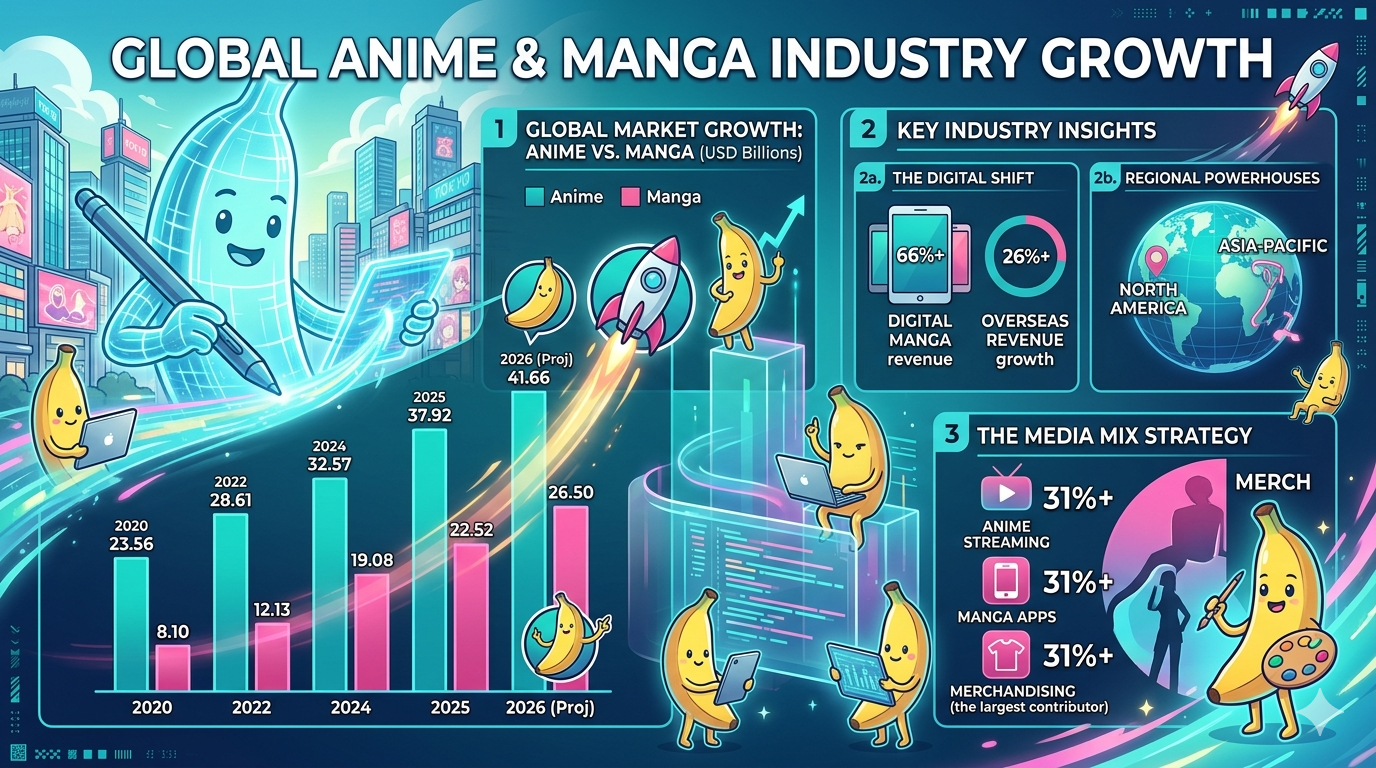
The anime and manga industries have transitioned from niche cultural exports to foundational pillars of the global entertainment economy. Between 2010 and 2026, the combined market value has nearly quadrupled, driven primarily by the “streaming revolution” and a massive shift toward digital manga consumption.
| Year | Anime Market (USD B) | Manga Market (USD B) | Total Industry Value | Key Milestone |
| 2010 | $15.90 B | $5.40 B | $21.30 B | Initial expansion into overseas TV broadcasting. |
| 2015 | $18.22 B | $4.90 B | $23.12 B | Streaming (Netflix/Crunchyroll) begins to scale. |
| 2018 | $21.50 B | $5.15 B | $26.65 B | “Overseas revenue” begins closing the gap with domestic. |
| 2020 | $24.23 B | $5.80 B | $30.03 B | Pandemic Boom: Sales exceed $¥600$B in Japan for first time. |
| 2022 | $28.61 B | $12.13 B | $40.74 | Digital manga (apps/webtoons) overtakes print. |
| 2024 | $32.57 B | $19.08 B | $51.65 | International revenue now accounts for 56%+ of anime. |
| 2025 | $37.92 B | $22.52 B | $60.44 | Merchandising becomes the single largest revenue stream. |
| 2026 (projected) | $41.66 B | $26.50 B | $68.16 B | Emerging markets (India, SE Asia) drive record growth. |
[Key Points For Growth]
- The growth is not just from watching shows or reading books. The Merchandising segment (figures, apparel, collectibles) is actually the largest revenue contributor for the anime industry, accounting for roughly 31% of total value in 2025. This creates a sustainable cycle where manga sells the story, anime markets the characters, and merchandise funds the next production.
- In 2024, digital manga sales reached a record high of $¥512.2$ billion, while traditional print magazines continued to decline.
- Approximately 66% of all manga revenue now comes from digital platforms.
- Over $13.8$ billion in revenue was generated from overseas markets in 2024 for anime, a 26% year-on-year increase.
- As of early 2026, the Japanese government has formalized the “New Cool Japan Strategy,” reclassifying the anime and content sectors as foundational pillars of the national economy—similar to automotive manufacturing. This is a response to international demand, finally decoupling from Japanese domestic trends; the world is now setting the pace for production.
- Projected growth according to Mordor Intelligence is 56 billion for the manga industry by 2031.
Despite growth, the Working Conditions still Suck for Animators
The way anime studios make money is different value proposition how things work in the west, to give you a good idea – there is a committee which consists of Japanese TV Station, Record Label, Toymaker, Main Publisher and then anime studio – if the shows makes 200,000$ only 20% roughly goes back to the anime studio as they aren’t really getting cut from merchandise which is currently biggest pie of everything in terms of revenue.
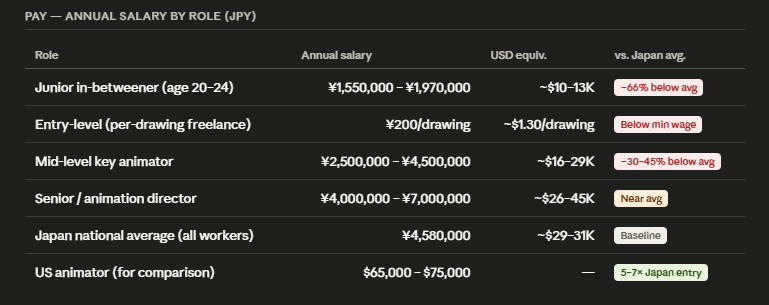
It also doesn’t help that the wages at these studios are very abysmal. Here is a chart comparing the national salary average in Japan for workers, but also for your US-based animators.
Even if we agreed that there are jobs that are always going to be below national averages, that doesn’t really excuse poor working conditions when it comes to the labor hours.
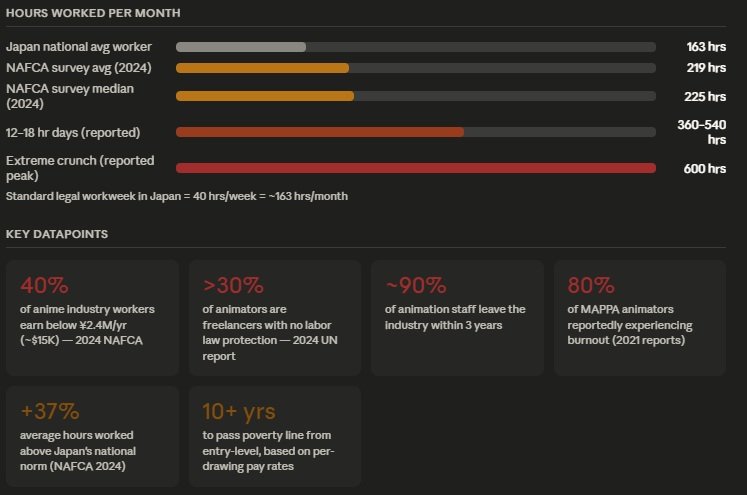
There are still some key problems in the payment structures, such as the industry standard being per drawing unit price being at ~¥250, which is incredibly low. It also doesn’t help that ~30% of the animators are “freelancers,” meaning they are not protected by labor laws, no overtime pay, no benefits, or guaranteed minimums. It’s also shocking when these people are doing overtime, their wages still suck, even when they are doing these massive overtime hours and still hitting below national averages. Also, veteran talent is leaving the industry faster than new ones are being trained…
The per-drawing pay model is the root of the problem. The unit price for animation has been around ¥250 per drawing, and that figure hasn’t changed in over 10 years. Even if an animator produced 300 units a month, they would only earn ¥75,000 — roughly $500 — making it impossible to survive on animation work alone – especially when 90% of studios are located in Tokyo which is most expensive place in Japan to live in.
The international pay gap is stark. The average animator in America earns around $65,000–$75,000 annually, while the anime industry operates a $25 billion global market comparable in size, yet pays entry-level workers less than a tenth of that.
IP Prison Dilemma
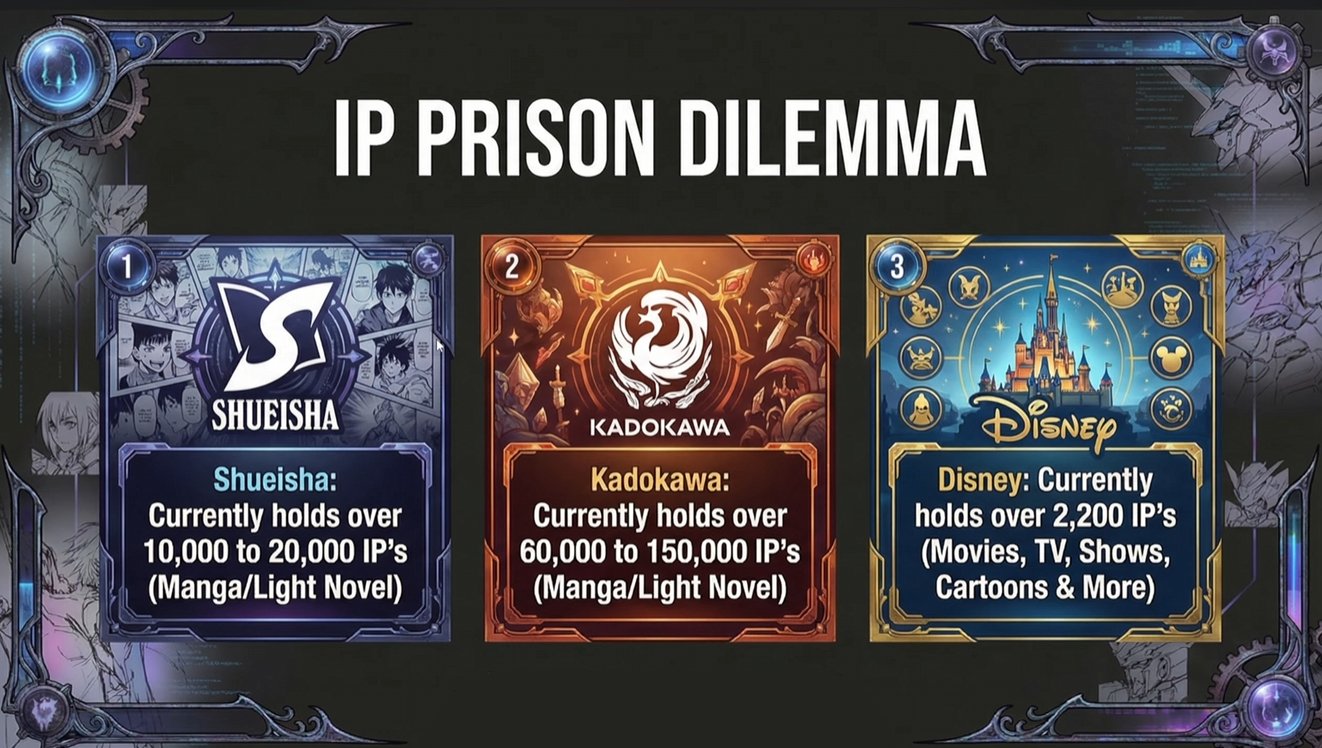
Now I’m going to take full credit for coining this term, but what IP Prison means is that you have a publisher like Kadokawa, Disney, or Shueisha, for instance, who has acquired through mergers, acquisitions, or just through creative endeavors a multitude of IP’s and franchises under their belt. Still, realistically, even if they went non-profit, they wouldn’t have the capital to adapt even 1% of their total IP portfolio into animated shows.
I think this is particularly true in Japan, which has a rich selection of manga and even light novels that are worth visiting. Here is the top 20 manga that have made millions, but have yet to receive an animated version – some of these have received live action ones, possibly.
| # | Title | Author | Circulation (Est.) | Start Year | Duration / Status |
| 1 | Vagabond | Takehiko Inoue | 82 Million+ | 1998 | 28 Years (Hiatus) |
| 2 | 20th Century Boys | Naoki Urasawa | 36 Million+ | 1999 | 7 Years (Completed) |
| 3 | Yotsuba&! | Kiyohiko Azuma | 17 Million+ | 2003 | 23 Years (Ongoing) |
| 4 | Real | Takehiko Inoue | 16 Million+ | 1999 | 27 Years (Ongoing) |
| 5 | The Climber | Shin-ichi Sakamoto | 12 Million+ | 2007 | 5 Years (Completed) |
| 6 | I Am a Hero | Kengo Hanazawa | 8 Million+ | 2009 | 8 Years (Completed) |
| 7 | Holyland | Kouji Mori | 7 Million+ | 2000 | 8 Years (Completed) |
| 8 | Choujin X | Sui Ishida | 4 Million+ | 2021 | 5 Years (Ongoing) |
| 9 | Goodnight Punpun | Inio Asano | 3.5 Million+ | 2007 | 6 Years (Completed) |
| 10 | Fire Punch | Tatsuki Fujimoto | 3 Million+ | 2016 | 2 Years (Completed) |
| 11 | Blood on the Tracks | Shūzō Oshimi | 2.5 Million+ | 2017 | 6 Years (Completed) |
| 12 | Kindergarten Wars | You Chiba | 2.2 Million+ | 2022 | 4 Years (Ongoing) |
| 13 | Gokurakugai | Yuto Sano | 1.4 Million+ | 2022 | 4 Years (Ongoing) |
| 14 | Nue’s Exorcist | Kota Kawae | 1.3 Million+ | 2023 | 3 Years (Ongoing) |
| 15 | Spirit Circle | Satoshi Mizukami | 1.2 Million+ | 2012 | 4 Years (Completed) |
| 16 | Ruri Dragon | Masaoki Shindo | 1.1 Million+ | 2022 | 4 Years (Ongoing) |
| 17 | Billy Bat | Naoki Urasawa | 1 Million+ | 2008 | 8 Years (Completed) |
| 18 | Centuria | Tohru Kuramori | 800,000+ | 2024 | 2 Years (Ongoing) |
| 19 | Wild Strawberry | Ire Yonemoto | 700,000+ | 2023 | 3 Years (Ongoing) |
| 20 | The Horizon | JH | 600,000+ | 2016 | 1 Year (Completed) |
The list above is mostly based on sales charts, but I’m arguing that’s not the only metric that should matter. Alita Battle Angel in anime format would be great to see, it clearly has an audience in the west, while not being super huge in Japan – on top of that, many shows got shitty anime original ending (Toriko) and series that have lot of arcs that aren’t done yet, good examples of these would be like BERSERK!, Hunter X Hunter, Hitman Reborn!, Kaiji and all time personal favorite the Silverfang (Ginga Nagareboshi Gin) franchise.
I’m not too fond of the idea of engaging in decades of e-begging to see a series come back – that is why consumer-level AI production is also an essential solution when the publishers don’t care about the IP’s they are holding – don’t get me wrong, there are plenty of bad manga and light novels out there which don’t need anime. Still, I feel like there are so many manga series that I would like to rather see than your generic new isekai series that doesn’t bring anything new to the table.
AI is the Solution for Crunch & Fan Demand
As it is evidently clear from the economic and labor data provided above, the industry is causing poor working conditions for unfair wages. The solution is to introduce a partial AI workflow that will allow artists to create backgrounds with Gen AI or just create otherwise hard 3D scenes that would look wonky in an animator’s hands. What Gen AI like Seedance is really good at right now is exactly the transition between 2D and 3D art and making it look realistic and optimal flow.
Some people are making the argument that AI would replace jobs, but the reality would be just that one animator would be onboarding the technology as a Tool and that would make them deliver things at a faster pace, even if they kept the same wages – this would allow them to produce work faster and we wouldn’t have to wait 3 years for our favorite anime to come back – which has become insanely bloated issue as of late across the board. There are multiple moral ways to bring this workflow to each studio, with examples such as
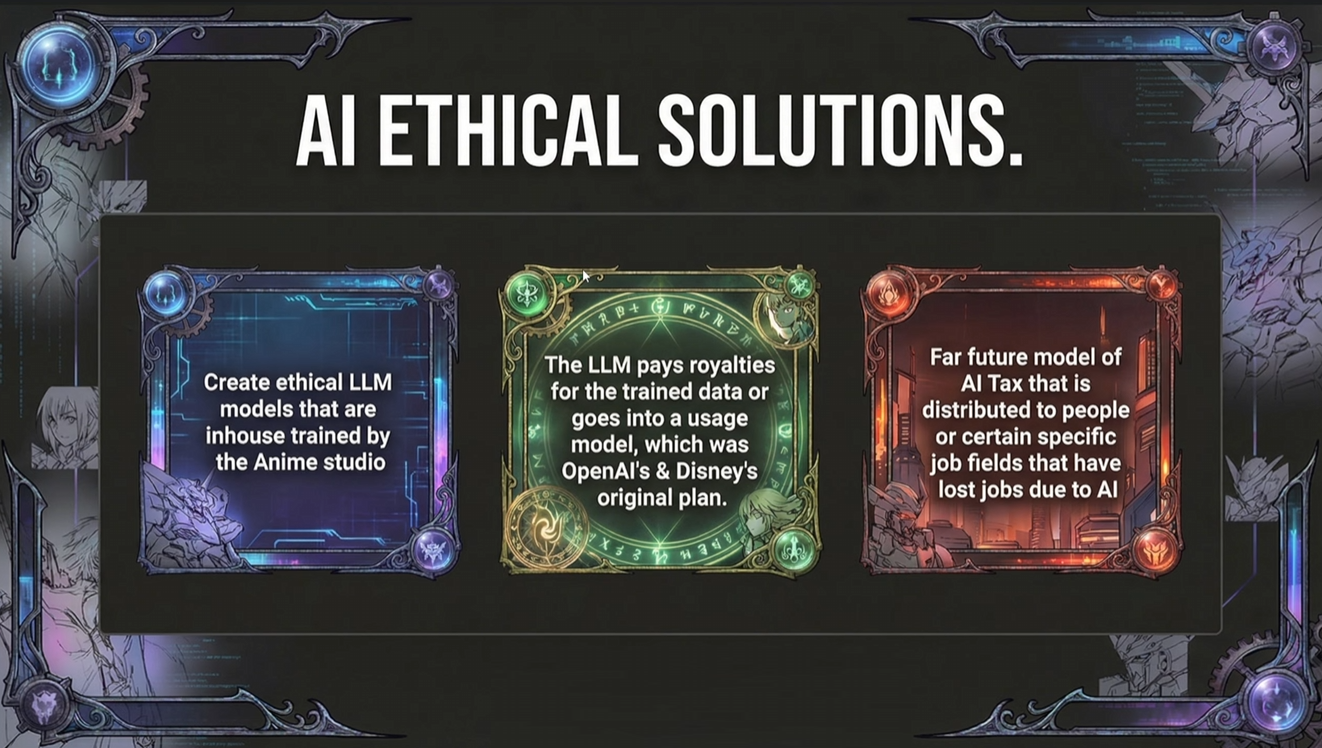
- In-house Trained LLM – using animation data directly and only from the studio’s own work, so they have the respective rights to that content, and nobody can accuse them of stealing.
- Royalty Models – You can implement LLM companies paying royalties when certain characters or their art is being used as a training method for an LLM. This is a bit harder to operate, but it’s plausible.
- AI Taxes – Create taxation on AI companies, and that tax is directly distributed to the industry in which that AI is operating, like Generative AI LLM money would be distributed to production companies, mangakas, and other artists like anime studios. This is a bit further in the future thing, but I think it’s plausible.
- Japanese Operating License for LLM – I think the best solution yet might be that Japan will allow only certain Generative AI models to operate and they have to pay tax which is then distributed to artistic fields, like the example above, this could create a situation for a monopoly too where one LLM is only able to operate and that is the only one the studios are allowed to use in their workflow.
Luddite Resistance is Futile
I already addressed a few arguments against Generative AI in the video, but I don’t want to exactly repeat the same stuff. I do want to stress the fact that China is currently fully embracing AI production at the national level, and the community is also doing that on a wider scale. Even if Japan puts a total ban on generative AI, it just means that foreign companies are going to issue their commissioned work from China, which leaves Japan cut out of a lot of revenue overseas from potential partnerships.
The Luddites were rejoicing earlier when SORA was shut down by OpenAI, but they didn’t really understand the full picture – since most of these models are actually open source, and with future compression techniques, we are going to see Seedance 2.0, maybe being able to run on a local PC in the near future. The cat is mostly out of the bag at this point, and doing a full backtrace on this technology is not going to happen, and the only way that would even happen would require shutting down the internet.
Luddites have to ask themselves right now, are they going to embrace the new technology, or are they going to get left behind by society as others move forward?
Consumer AI Revolution
Already back in 2024, I wrote about this moment, which I dubbed “Anime Industrial Revolution“. I can safely say with the arrival of Seedance 2.0, it’s now here and things are going to improve drastically going forward to next year – while we are still in that 15-second limitation here, it’s already enough to stitch up episodes together and create full productions. We showcased some of these excellent AI Anime in our previous article a while ago.
I believe by next year we are going to have 2-4 LLM’s that are able to produce video clips that will be 30 seconds long, which will be enough to have good dialogue scenes or action ones, which will improve drastically production for a full-length anime episode. It’s actually surprising, however, how much you can condense even on 15-second clips as well.
But don’t get hung up too much on the production flow. What is important is the actual end of the products, and here is what I’m expecting will happen!
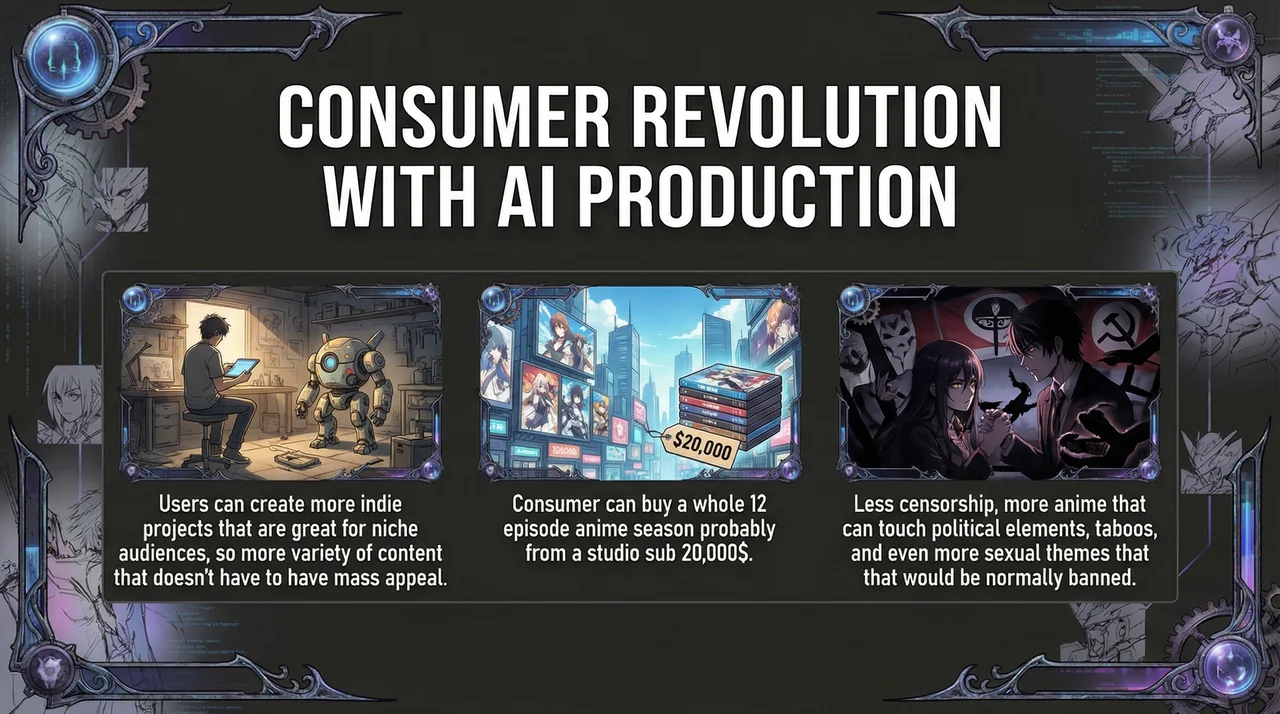
- More Niche Genres: When was it truly the last time we received a good financial anime like Kaiji? I think it was literally when Season 2 came out back in 2009, and this year we are going to get one about stock trading, but the reason why we aren’t getting these types of things is because its a niche market. The audience isn’t necessarily enough to justify the cost, but now we actually have production costs drop by tenfold, which means more risky and niche ideas can be embraced
- Commission Anime: Today’s cost of an anime episode is roughly between 150k to 300k, depending on which studio is doing it. In the near future, a whole 12-episode season likely can be produced for a ballpark of 20-50k, most likely depending on how much of the production is AI-based.
- Less Censorship: Even Japanese anime industry has certain taboos and things they cannot show on public TV for various reasons, since we don’t have to get through some bureucratic process to tailor the anime to be sensitive to japanese or western audiences, there is simply going to be more artistic expression on the end product without having to give a fuck will it be palatable to the mass audience.
We have to remember that this movement represents quite a lot of the Webmanga era titles like Solo Leveling, One-Punch Man, Mob Psycho, and Tower of God. Which all initially started as people doing stuff for free, and then eventually expanded into mainstream by getting partnerships and anime adaptations.
I do believe that there is still a big Luddite sentiment regarding AI-produced anime that have been published by creators, until they are fully embraced and build an actual following, which will take some time. Whatever it will be, the Japanese or Western audience that will embrace it first remains to be seen.